
A guide for schools and education professionals
Updated: September 2025
Firstly, we would like to welcome you to Portsmouth and to wish you every success in your role working with children and families in the city. We have developed this guidance as an induction for education colleagues who are new to Portsmouth and/or new to the sector of children, families and education.
We recognise that navigating everything there is to know about safeguarding and education can be challenging, especially in an ever evolving and changing workforce; therefore, we have developed this guide to help support you in your new or existing role.
Portsmouth is a restorative and relational city; we pride ourselves in putting children’s best interests at the heart of everything we do, working alongside families to achieve the best outcomes. We hope that the ‘Welcome to Portsmouth’ guidance for professionals will help to point you in the right direction for all the information that will be useful to you within your new role. If you do have any questions or queries regarding any of the information in this document, then please do get in touch.

About Portsmouth
Portsmouth is a large port city in Hampshire on the south coast of England. With a population size of 208,100 it remains the local authority with the highest population density outside of London, with around 37 people living on each football pitch-sized area of land.
Portsmouth is proud of its naval history. The historical dockyard has the oldest dry dock and is home to some famous ships, including HMS Warrior, The Mary Rose and Lord Nelson’s flagship HMS Victory.
The city of Portsmouth and Portsmouth Football Club are both affectionately nicknamed ‘Pompey’.
Over 48,000 children and young people under the age of 19 years live in Portsmouth and approximately 40,000 are school age. There are 46 primary schools, 9 secondary schools, 1 all through school, 5 special schools, 1 University Technical College and 1 GFE college and 4 independent schools.
It is estimated that 21.4% of the local authority’s children are living in poverty (the England average is 18.5%). Portsmouth is ranked 59th of 326 local authorities for deprivation where 1 is the most deprived. 4.3% of school aged children have SEMH (the England average is 3%).
Children and young people from majority ethnic groups account for 27.4% of all children living in the area, compared with 35% in the country as a whole.
Restorative and Relational Practice
In 2016, Portsmouth chose relational practice as ‘the way we work with families’. The city continues to be committed to embedding the language, practice and principles within a restorative framework. Relational and restorative practice also reflects and informs the way we work with families, providing high support alongside high challenge. It also informs how we work together as professionals within and across agencies.
Portsmouth Model of Family Practice
The vision for Portsmouth children and families services is the concept of family practice. This means:
- Working whole family: Strong families are the bedrock of good outcomes for children. Being child-centred means understanding the whole family dynamics, in terms of risk and protective factors. We are there for all members of the family and need to address adults’ issues to help them care for children.
- Restorative: Working with the family – and with each other – to co-produce solutions for that family.
- Relational: Developing and sustaining strong intra-familial relationships through strong relational practice with families, supporting families to stay together as a bonded unit.
- Trauma-informed: Understanding the impact of past and current trauma on the capacity of families to make and sustain relationships, make changes and on child and adult behaviours.
- Strengths-based and compassionate: We seek to understanding the need behind the behaviour. ‘Flipping the Narrative’ … parents aren’t ‘lying’ – they may be fearful; parents aren’t ‘angry’, they may be frightened.
- Holistic: Understanding all aspects of a family lives using the Assessment Framework.
- Hopeful: We expect and enable change to keep children safely living at home wherever possible and remain ever-confident of the capacity of the family to make changes, while continually testing all possible narratives against the evidence to ensure we are sufficiently protecting children.
- Informed by difference: We recognise the significance of difference and the role difference and language plays in structuring the meaning and experience of the world.
The goal of all schools should be to establish the best possible climate for learning for students. Students learn best when they feel safe, not just physically but also emotionally. Feeling safe means feeling valued, respected and included in school life. [Restorative Schools | European Forum for Restorative Justice]
Relational and restorative practice provides a framework for creating and sustaining a school climate where teaching and learning can take place effectively and where students and adults can thrive as they learn from each other.
Creating a relational and restorative school is a deliberate act of design that flows through structure, policies, procedures, and everyday interactions.
Relational practice describes a way of being, an underpinning ethos, which enables us to build and maintain healthy relationships. It provides a strong framework within which we can promote a whole-school ethos founded on the importance of relationships. This includes a range of approaches to managing conflict and tensions in a way that repairs harm and mends relationships if and when these relationships do break down.
Although its roots are clearly in restorative justice – as a way of repairing harm – restorative practice has the bolder ambition of proactively developing the sense of community and seeking to increase the social capital between and across the school and, from there, into the wider community. [Restorative Practice, Mark Finnis, 2021, Independent Thinking Press]
The underlying premise of restorative practices rests with the belief that people will make positive changes when those in positions of authority work with them, rather than doing things to them or for them. This is achieved by providing a combination of high challenge and high support.
‘Challenge’ does not mean confrontation, but setting, rules, limits, and expectations.
There are consequences to actions, concerns are outlined openly and honestly, and responsibility and accountability are encouraged. ‘Support’ includes ensuring people have the tools to meet the expectations and are shown empathy, encouragement, compassion, kindness and respect.
For more information:
Relational and Restorative Practice in Education – Portsmouth Education Partnership
Restorative practice – Portsmouth Safeguarding Children Partnership
If your school would like to find out more about restorative and relational practice, please contact Bec Mason, RRP in Education Implementation Lead: [email protected]
Family Support Plan and Early Help
For comprehensive information about the Family Support Plan, please always use the PSCP website.
In summary, here are some details about Family Support in Portsmouth:
What is Family Support in Portsmouth?
Family Support is our approach to delivering early help to families in Portsmouth. Its aim is to ensure that we are providing the right support to families, at the right time, to achieve positive and lasting change.
The main focus is to improve outcomes for children and prevent any situation from escalating or further problems arising.
What is a Family Support Plan?
A Family Support Plan (FSP) should be used when families have agreed to receiving early help. The FSP will help to identify the family’s strengths and the challenges that they may be experiencing and agree a plan to support the identified needs.
A conversation takes place at a meeting with the family and professionals who will discuss the following 10 aspects of life:
- Getting a good education
- Pregnancy and early years
- Good physical and mental health
- Reducing the impact of substance misuse/addiction
- Good family relationships
- Keeping children safe from harm
- Keeping children safe from crime
- Healthy relationships
- Secure and suitable housing
- Financial stability
There is a short video to explain the FSP process to families.
Who co-ordinates a Family Support Plan?
The FSP is led by a co-ordinator who is either:
- A Lead Professional from a school/health etc. (Tier 2/low Tier 3 of need)
- A family support worker from the Early Help and Prevention team (Tier 3 of need)
Identifying families who might benefit from Family Support
You should always refer to the Thresholds Document to consider where a family’s needs fit on the continuum of need, to ensure that you are offering the right support at the right time.
There are many reasons for which a family may benefit from Family Support.
Families who would benefit from an FSP will typically have needs within either Tier 2 or 3 of the continuum of need, the FSP can also be used to help identify support needs alongside a Educational Health and Care needs assessment:
Tier 2 – Additional Offer:
Child/young person has additional needs that can be met by support from one or two agencies working with the family. Family Support Plans are used by the Lead Professional (usually school/health/early years/voluntary org, etc.) to co-ordinate support.
Tier 3 – Targeted Offer:
Children in families with increasing levels of multiple and complex problems. Families require a co-ordinated, whole family approach led by a lead worker or key worker, enabling the family to meet the children’s needs.
Family Support Plan
FSP Portal
The FSP Portal is a digital solution to completing the Family Support Plan.
The FSP Portal allows you to complete the Family Support Plan directly onto the portal, work collaboratively with others, and have an overview for all the children that have an FSP.
Key benefits of the FSP Portal include:
- Digital solution – A digital version of the FSP form
- Case management overview – Clear view for all children who have an FSP that you are either the lead or part of the team around the family
- Include other professionals – You can add in other professionals who are part of the TAF, they will be able to view the FSP and Plan
- Review reminders – The portal will show at 6- and 12-week periods when a review is due
- Review will pre-populate – When starting a review, this will pull through all previous information from the original FSP
- Actions will pre-populate – Actions from the plan will pull through and allow for an update and to show progress and changes
- Transfer cases – If stepping across to another lead professional, you can transfer the ‘FSP Coordinator’ role
- Download and print – You can download the FSP to enable it to be uploaded to your own system or print for the family
Resources to help with FSP – support for families and professionals
For each of the 10 aspects of life, there is a comprehensive online directory of links to support and services called the The Directory of Services.
FSP training (Early Help)
Portsmouth Safeguarding Children Partnership (PSCP) offers training in Early Help to support and equip key professionals with knowledge and skills to undertake ‘early help’ practice – using the Family Support Plan, Team Around the Child processes and the Lead Coordinator role. Details of dates and how to book onto this course can be found on the PSCP website.
Safeguarding in Portsmouth
Children, Families and Education Services
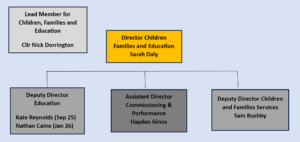
The Director of Children, Families and Education Services (DCS) is a statutory role that has responsibility for Education Improvement, Special Educational Needs and Children and Families Services.
The diagram below shows the senior management structure within the Children, Families and Education directorate.
Portsmouth Children’s Trust Plan
Portsmouth City Council Children, Families and Education Directorate delivers a range of services and functions to discharge the key responsibilities of top-tier local authority. In addition, close and mature partnership working with health commissioners and providers enables many of those functions to be integrated with the local NHS system.
The Children’s Trust Plan sets out the six strategic priorities for improving the lives of children and families in the city and how partner agencies will work together to support families and children.
- Portsmouth Education Strategy: 9 strategic objectives
- Portsmouth Safeguarding Strategy: 8 strategic objectives
- Portsmouth Children’s Public Health Strategy: 8 strategic objectives
- Portsmouth SEMH Strategy: 10 strategic objectives
- Corporate Parenting Strategy: 8 strategic objectives
- Portsmouth SEND Strategy: 7 strategic objectives
Key Teams within Safeguarding
MASH – Multi-Agency Safeguarding Hub
MASH is the single point of contact for any safeguarding concerns that you may have for a child in Portsmouth. Any concerns should be reported via an Inter-Agency Contact Form (IACF) or by phoning 02392 688793 or 0845 671 0271.
The Portsmouth MASH was established in November 2015. It is the multi-agency front door that manages child safeguarding and welfare concerns and determines an appropriate response to support those children and families. It sits within the Family Support and Safeguarding sector in Children’s Social Care. The services represented within MASH are Children’s Social Care, Early Help and Prevention, Hampshire Constabulary, Solent NHS Trust (commissioned through ICB), Youth Offending Team, Youth Service and Education.
There are also clear links with Housing Department in PCC to share information and developments are in place to reintroduce Probation as a partner sat in MASH. The benefit is that they can quickly share information and make decisions as to the required level of intervention, offering a response across the tiers of need.
Please refer to the Portsmouth threshold document to help inform your decision making in regard to tiers of need and thresholds for contacting MASH.
Always follow your school policies and procedures and discuss any concerns with your Designated Safeguarding Lead (DSL).
When working with children and families you will encounter a wide range of concerns in relation to their safety and wellbeing. The Portsmouth Safeguarding Children Partnership (PSCP) provides information across a range of issues and guidance on how to respond to them.
Family Support and Safeguarding – Tier 4
There are 4 Family Support and Safeguarding Teams, based on a locality model, Central 1, Central 2, North & South. Central 1 & 2 and South are based in Civic Offices, whilst the North Team are based at Medina House in Cosham. Alongside these 4 teams is a team of adult workers: Domestic Abuse Practitioners, Recovery Workers and Adult Mental Health Workers who are co-located in the childcare teams and have a graded offer. They will work directly with a parent/adult in the family on their adult need, they will support the Social Worker/Network to work with the parent and support connections with specialist services, or they may do a one-off piece of work.
Social workers in these teams will complete initial assessments for families who meet a tier 4 threshold. The assessment will determine whether they need ongoing social work support, usually either as Child In Need (S17) or Child Protection (S47). They will complete Child Protection enquiries where there are concerns a child is suffering, or at risk of suffering, significant harm and take the lead role with children subject to Child Protection Plans. If concerns escalate, the social workers in these teams will manage the Public Law Outline process, both pre-proceedings and work in the Court arena.
Children We Care For
Fostering
Fostering is giving a child a stable and caring home when their parents are unable to look after them. Portsmouth foster carers provide a safe place and the support that these children and young people need to thrive, whatever situation they have come from. A weekly allowance is paid to the foster carers to cover the costs of looking after the child.
A more recent innovation in fostering has been the use of the Mockingbird programme. For more information about this programme please contact the Mockingbird Liaison Offer at [email protected] or visit The Mockingbird Model of foster care.
Building Your Future
The Building Your Future Team provides social work support to our children in long-term care placements and support reunifications back to their family or extended family.
Family Time
The Family Time team facilitate family time arrangements for families in court proceedings. This team is made up of several experienced family practitioners who are able to contribute to the final care plans for children. In addition to supporting family time arrangements, they are also able to provide specialist intensive family support to enable safe rehabilitation plans to be progressed within court proceedings.
Family time is arranged by the allocated social worker.
Adoption Team & Special Guardianship Order (SGO)
Adoption is the legal process by which a child or a group of siblings who cannot be brought up within their birth family become full, permanent and legal members of their new family. Adopters become the child’s legal parents with the same rights and responsibilities as if the child was born to them.
A Special Guardianship Order secures a child’s long-term home with someone who is not their parent. It lasts until the child turns 18. Special guardians gain an enhanced form of parental responsibility. This means they can use their parental responsibility to the exclusion of others.
Special guardians should still consult parents and others with parental responsibility about important decisions for the child. But they can make final decisions about most things if needed.
Children’s Homes
Currently in Portsmouth we have three Children’s Homes managed by the City Council, consisting of Tangier Road, The White House and Beechside.
Looked After Children and Care Leavers Service – Intranet
Adolescents and Young Adults
Supporting Your Future
The team are responsible for care-experienced young people and for unaccompanied children who come into the care of the Local Authority. Staff in these teams are responsible for ensuring that our statutory responsibilities for children we look after and care-experienced are properly met.
Staying Close Project
The Staying Close Aspiration project is designed to provide young people leaving residential settings with the additional support and nurture they need to help them develop the skills they need to live independently. Each young person who is referred to the project will meet with their designated Personal Advisor and the CAMHs practitioner to have an individual assessment of their needs.
Youth Justice Service
Portsmouth ‘Youth Justice Service’ undertake a range of work including:
- ensuring Appropriate Adults (AAs) are available to children in police custody
- Turnaround Youth Justice service to children on the cusp of youth crime
- providing a Court Duty service to Youth, Magistrates and Crown Courts – including assessments for bail and remand and Pre-Sentence Reports
- supervising Youth Justice Disposals (pre-Court, community and custodial) in collaboration with a range of partners
- supporting parents and carers of children who have offended or are at risk of doing so
- offering Restorative Justice (RJ) options to victims of youth crime
- delivering our Junior Attendance Centre on Saturdays
Referrals to the Youth Justice Service come directly from the Police or courts. The team can respond to queries on a more general basis and be contacted on 02392 688450 or at [email protected].
Adolescent Service
Adolescent service is a multi-disciplinary team consisting of restorative practitioners, mental health practitioners, DASS (drug and alcohol support service), counsellors and a MET coordinator. The service offers four services, DASS, missing, supporting families and supporting safety. Supporting families is a 12 week intervention offer supporting children and young people at risk of entering local authority care to remain within their families, through a restorative approach and utilising DDP and PACE approaches. Supporting safety offers direct work to children and families focused on children and young people at risk of exploitation. Referrals for this service are completed by the allocated social worker.
The missing element of the service provide return discussions for children and young people after a period of missing, signposting to further support where required. DASS service offers confidential support to any child regarding substance and alcohol use in the city of Portsmouth.
Early Help and Prevention (EHP) – Tier 3
Targeted Early Help and Prevention engage with the whole family for up to 6 months. MASH identifies that they require Tier 3 support. Together, the family will complete a Family Support Plan and work to focus on the specific needs of the family to help them make positive changes. Families can also be stepped down to EHP from FSS or stepped up when the threshold requires it.
Within this service are the three locality-based Early Help and Prevention teams and community and public health services, including Health Visiting, School Nursing and the Family Nurse Partnership.
Portsmouth City Council’s early help services (family hubs, youth work, etc) with community public health services has allowed a seamless offer for families with children aged 0-19.
Early Help and Prevention Locality Teams and Public services (schools, police and health) have been organised into three cluster areas in Portsmouth: the north of the city, the centre of the city and the south of the city.
The Early Help and Prevention teams provide the healthy child offer for pre birth-5s, parenting support and bespoke packages of support facilitated by a lead professional building on the idea of ‘team around the worker’, so that relationships are built with a key professional who can be supported by other professionals to provide direct work, rather than a referral on actions.
Family Hubs are for families with babies, children and young people from birth until they reach the age of 18 (or up to 25 for young people with special educational needs and disabilities). Portsmouth’s Family Hubs are delivered through a formal partnership between Portsmouth City Council and Solent NHS Trust. There are Family Hubs in Buckland, Somerstown, Milton, Hilsea and Paulsgrove. There are family Hub champions based within the hubs that families can speak to for support and advice.
Parenting support
There is a full timetable of parenting support for all children and families both on line and within Portsmouth Family Hubs for children prebirth to 18.
Targeted youth offer
Early help and prevention also run a targeted youth offer for young carers and LGBTQ+ young people including youth groups based within the Family Hubs.
Wellbeing in Education
For a child with below 30% attendance and anxiety the Early Help practitioner can refer internally to the Wellbeing in Education team. They can provide more intense support and are trained in engaging children and young people to improve their attendance. This is a decision made by the practitioner and their supervisor.
Early help and prevention service – Portsmouth City Council
Children with Disabilities
This is based within children’s Social Care and Safeguarding service. This function is situated within the Locality and Children We Look After Social Work Teams and the South Locality Early Help Service. The service carries out the Local Authority’s statutory duties in respect of disabled children as set out in the Children Act 1989. They aim to provide a high-quality service to children and young people with profound disabilities and complex needs between the ages of 0 – 18 years. If you are receiving support from the team post 18, they will ask permission to make a referral to adult social care.
Childrens Disability Service – Portsmouth SEND Local Offer
Further safeguarding information and services
All information can be found in the separate section for resources.
This is not an exhaustive list but an idea of other services available in Portsmouth for professionals, children and young people and parents:
- Children seeking safety and asylum – where to get support and find what is available
- Counter Extremism – Prevent for radicalisation, FGM etc – information and support
- Crime Prevention Portsmouth – how to report crime and receive support
- Domestic abuse support – Stop Domestic Abuse, Up2U – support for victims and perpetrators
- Exploitation – county lines – criminal and sexual exploitation, knife crime and gangs
- Online safety – lesson plans, information for children and parents
- Poverty – where to get support and what is available
- Substance misuse – for adults or young people and for impact of parental substance misuse
- Young carers – how to identify, what support is available
Additional information can be found in the Directory of Services.
LADO
The Local Authority Designated Officer is responsible for overseeing the investigations of allegations made against volunteers or members of staff in ‘positions of trust’ and who work with children (up to 18 years).
Local Authority Designated Officer (LADO) – Portsmouth City Council
LA Education Link Coordinators – see Education
The Link Coordinators provide an operational, supportive link between schools and the local authority, ensuring that schools and other education settings are aware of their vulnerable children and the key professional networks working with those families.
Police and PCSOs
Each school has an allocated PCSO (colleges have a PC) who will make regular contact with schools. They will also arrange to engage 3 times in a school year to deliver specific sessions on County Lines, hate crime, knife crime, internet safety and ASB. This is arranged by the school and their PCSO. Schools will have a copy of the Safe4me School Charter which outlines the main aims and objectives of the partnership.
The main inbox for contact is: [email protected]
Portsmouth Safeguarding Children Partnership (PSCP)
Under the Working Together guidance Local Authorities are required to have local multiagency arrangements to oversee safeguarding activities. Most local authorities have set up Local Safeguarding Children partnerships to manage these arrangements. The Portsmouth Safeguarding Children Partnership has an independent chair and a business manager who co-ordinates the work of the Partnership and its various sub-groups.
Visit the Portsmouth Safeguarding Children Partnership website to find out more.
Hampshire, Isle of Wight, Portsmouth and Southampton (HIPS) Procedures
HIPS procedures provide overarching guidance and procedures on safeguarding issues which are agreed by all four authorities.
Joint Action Response (JAR)
The purpose of a Joint Agency Response meeting is to ensure that the appropriate agencies engage and work together to: Respond quickly to the unexpected death of a child. Make immediate enquiries into and evaluate the reasons for and circumstances of the death, in agreement with the coroner.
Re-Think
When working with professionals from other agencies there will at times be differences of opinion and exchanging ideas from different perspectives should not be under-estimated.
Portsmouth Safeguarding Children Partnership (PSCP) is committed to supporting the professional network when there has been and continues to be a difference of opinion, a feeling of ‘stuckness’ and/or limited progress. Resolving concerns should be seen as an integral part of how we advocate for children and their families in Portsmouth
Resolving professional differences – Portsmouth Safeguarding Children Partnership
Education Services and Information
Portsmouth City Council website
Provides information and resources for teachers and other school professionals.
School professionals – Portsmouth City Council
Portsmouth Education Partnership (PEP)
The PEP brings together all Portsmouth schools and partners to improve attainment and opportunities for all children and young people across the city.
Home – Portsmouth Education Partnership
Safeguarding in Education
Everyone who comes into contact with children and their families has a role to play in safeguarding children. School and college staff have a particularly important role as they have regular contact with children, so are in a good position to be able to identify concerns early that a child may potentially be at risk of or experiencing abuse or neglect.
Safeguarding in education – Portsmouth Safeguarding Children Partnership
School Attendance Team
The School Attendance Team is part of the Inclusion Service in Portsmouth City Council’s Education Department. The team’s role is to ensure that the Local Authority discharges it statutory duty in relation to school attendance, children’s whereabouts, elective home education, children in employment and children in entertainment.
School attendance – Portsmouth City Council
Admission, Exclusions, and Reintegration team
The Admissions, Exclusions and Reintegration Team aims to ensure that all those entitled are provided with full-time provision in a timely fashion and that placements are maintained wherever practicable, or solutions found where alternatives are required.
School Admissions
All the information needed to apply for a school place in Portsmouth.
School admissions – Portsmouth City Council
Education Improvement
Education Improvement work with primary, secondary and special schools implementing effective strategies to improve teaching and learning.
Education improvement – Portsmouth City Council
School Attendance Panel (SAP)
School Attendance Panels are a time-focused process, which aims to ensure that intervention strategies are put into place and barriers are removed to support improving a pupil’s attendance. The panels also aim for the early identification of parents who fail to co-operate with, or who are unwilling to work with the school. Appropriate action will then be taken to ensure that they take responsibility for their child’s school attendance.
The SAP is most appropriate for those pupils’ families with a history of irregular attendance, previous legal proceedings against the parents, other agency involvement, lack of parental engagement or cooperation, where intervention like PSP or FSP have failed to improve attendance, and where it appears parents are coding absences. This is not an exhaustive list and is for guidance only.
All referrals are submitted via the online form.
Unauthorised absence
At the head teacher’s discretion, absence may be authorised for genuine illness, or for reasons of religious belief or for family trauma. Any absence not approved by the headteacher is an unauthorised absence. The form below is to be used to request consideration of legal action for pupils who have taken unauthorised leave of absence.
Education – Pupil migration LA return
All schools must now inform their Local Authority when they are about to delete a pupil’s name from the admission register, no later than the day of deletion.
Education – Pupil migration LA return – Portsmouth City Council – Introduction – My Portsmouth
Children Missing Education
Every year children move between Portsmouth schools or leave the area for a school in another authority. Additionally, children arrive in the city needing to access education and may require support and intervention to do so. The purpose of this guidance is to outline both the legislative requirements and operational details for managing this responsibility, so that all parties understand their responsibilities and undertake them consistently and promptly.
Inclusion Support Panel (ISP)
Schools can request a change of provision for a pupil experiencing difficulties in education by referring to the Inclusion Support Panel. The Inclusion Support Panel (Fair access protocol and Dual Registration (FAP/DR)) was devised by Portsmouth Head Teachers as the process to arbitrate and make decisions (in line with the Fair Access Protocol) in an open and transparent way, involving representatives from all schools and other agencies.
Special Provision and Alternative Provision (AP)
A specialist facility which accommodates pupils who cannot attend mainstream school for a variety of reasons including exclusion, or mental or physical health difficulties.
The Special Provision Place Strategy focuses on Portsmouth-resident pupils with Special Educational Needs and Disabilities (SEND) who have an Education, Health and Care Plan (EHCP)
This document sets out Portsmouth City Council’s strategy for special educational provision and alternative provision places.
Attendance guidance document – A Graduated Response
This guidance document has been produced to offer guidance on steps to take at each stage, including a graduated response, supporting documents and support available.
School attendance – the tip of the iceberg
We have developed guidance on understanding and overcoming barriers to school attendance. This has been produced in collaboration by the Educational Psychology Service, Mental Health Support Teams and Multi Agency Behaviour Support Service. We have also sought the views of many different people in the city, including school staff.
We use the iceberg as an analogy that can help us start to understand the different factors that underlie school attendance and absence so that these factors can be addressed and supported. We use a primarily psychological and evidence-based approach to trying to first understand the unique situation of the child you are working with and then to help you generate ideas for practical ways to improve attendance.
Return to School Attendance Plan (formerly Personal Attendance Plan)
This document has been developed to complement Portsmouth’s ‘Attendance: The Tip of the Iceberg’ guidance for schools and to replace the widely used Personal Attendance Plans. Following careful discussion and an evidence-based review of what has proven effective in supporting attendance, this resource is available to support your attendance planning and formulation.
The Return to School Attendance Plan should be completed collaboratively by the school, the wider professional network and the family. The aim is to understand the context in which the child lives and how this may be affecting their school attendance.
Studybugs
The aim of Studybugs is to help the Local Authority and local schools tackle the issues underlying poor school attendance. With relevant, live data available to those who need it, the LA and schools will be in the best possible position to work closely together, intervene early and make a difference to the life prospects of children across the area. With their agreement and cooperation, Studybugs connects to the school’s system and gathers pupil attendance data in real time.
Inclusion
Special Educational Needs and/or Disabilities (SEND)
Information for parents, carers, young people and professionals about support and services for children and young people from 0-25 with SEND is available on the Portsmouth Local Offer website.
Children with special educational needs may need extra help because of:
- difficulties thinking and understanding
- physical or sensory difficulties
- emotional and behavioural difficulties
- difficulties with speech and language
- difficulties with mental health
- how they relate to and behave with other people
The website has information on events, education, health and social care and support groups. There’s a section for:
- children and young people with SEND
- their parents and carers
- professionals who work with children and young people with SEND
Social, Emotional and Mental Health (SEMH)
There is a clear-shared intention to adopt a whole system approach to developing and transforming the support for children and young people’s mental health and wellbeing. Fundamental to this approach is the importance of partnership working and that social and emotional mental health becomes ‘everyone’s business’ in the same way as safeguarding has become ‘everyone’s business’ across Portsmouth. Free training is available to all those working with children and families in Portsmouth to grow skills, confidence and capacity to support good mental health throughout everyday practice. Training can be found and booked via the Portsmouth Safeguarding Children’s website using the link below and searching ‘mental health’.
Portsmouth Safeguarding Children Partnership – Learning Management System
Mental health support for young people (SEMH) – Portsmouth City Council
Anti Racism Toolkit
Anti racism toolkit can be found on the PEP website.
Virtual School and College
The Virtual School and College ensures that all children we care for have educational provision that meets their need, and they receive support to secure good academic progress and attainment. They also provide support for children with a social worker and those in kinship arrangements.
Portsmouth Virtual School and College – Portsmouth Education Partnership
Inclusion Outreach
The Inclusion Outreach Service promotes good outcomes for children and young people with special educational needs and/or disabilities and aims to remove barriers to inclusion across the city, by providing a needs-led and flexible range of support to mainstream schools.
The Inclusion Outreach Service is available and free to all mainstream schools, delivered by a range of professionals from a partnership of services including: MABS, Solent Academies Trust, Children’s Therapy Service, and experienced Outreach SENCOs from mainstream schools in the city. The service aims to link schools with the most helpful advice and specialist support available.
Inclusion Outreach Service > Portsmouth Local Offer
SENDIASS
SENDIASS provide impartial information and advice for children and young people with SEND and their parents on education, health, and social care. It is a free and impartial service and is a statutory requirement of the local authority to commission the service.
Portsmouth SENDIASS: www.portsmouthsendiass.info | 0300 303 2000
Emotional Literacy Support Assistants
ELSAs are emotional literacy support assistants working in schools. They help children develop positive relationships, emotional literacy skills and helpful beliefs. They plan and deliver individual (and small group) support programs. ELSAs are trained and supervised by the Educational Psychology team.
ELSA – Emotional Literacy Support Assistants > Portsmouth Local Offer
Educational Psychology Service
The Educational Psychology Service helps promote all aspects of a child or young person’s development (aged 0-25), using Psychology to help children and young people reach their full potential.
Educational psychology service for schools – Portsmouth City Council
Mental Health Support Team (MHST)
MHST hopes to be able to help families by expanding capacity for early intervention whilst supporting schools and colleges to assist with ongoing support.
They aim to provide interventions to support those with mild to moderate needs whilst assisting with the promotion of good mental health and wellbeing together with education. They hope to support schools and colleges to build a collective understanding of local services to signpost and support families, as well as access to specialised help.
Mental Health Support Team (MHST) – Portsmouth Education Partnership
Neurodiversity (ND)
Portsmouth’s ND Team (0-19) consists of family support workers, child and adolescent clinicians, an educational psychologist, speech and language therapists and occupational therapy and service leads.
The team has been developed to support the city’s new ND pathway which aims to improve early identification of neurodiversity and offer increased support for families and professionals, meaning children and young people may not need to go through the lengthy assessment process to get their needs met.
Portsmouth Neurodiversity Team (custhelp.com)
CAMHS
Mental Health Support and Crisis helplines
Portsmouth Child and Adolescent Mental Health Service (CAMHS) provides a mental health service for 5 – 18 year olds suffering with acute, chronic or severe mental health problems. They provide assessment, treatment and support to young people and their families.
Inclusion Centres
An Inclusion Centre is a dedicated special needs centre attached to a mainstream school. It provides an inclusive education for children with specific needs who may find mainstream inaccessible at present but have the potential to be able to access mainstream classes over time. Our aim is to prepare children for working in mainstream, part-time initially, then slowly reintroducing them into mainstream education as and when they are ready. Inclusion Centres have fewer numbers of children and higher adult to child ratios of specialist staffing.
Inclusion Centres > Portsmouth Local Offer
Multi-Agency Behaviour Support (MABS)
MABS is a fully traded SEMH Outreach Service, consisting of a team of experienced Lead Teacher Advisors (working with school staff) and Pupil and Family Practitioners (working with pupils and families), supporting children, young people, families and schools with Social Emotional and Mental Health (SEMH) needs.
MABS uses a trauma informed relationship-based approach to promote and develop SEMH so that all children and young people can flourish in our school communities. Relationships are at the heart of everything we do, and we see our purpose as supporting communities and individuals to understand behaviour as communication and build healthy approaches to meeting needs and solving problems. MABS offers a range of needs led and evidence based support, both with individual commissioning schools, and across the city through Local Authority and Virtual School commissions.
Outreach | The Harbour School Portsmouth
Traded Services
Portsmouth’s ‘Traded Services’ are the set of services offered by PCC and our key partners to schools and other education settings (e.g. nurseries and childminders, colleges). Services are available to purchase through the Traded Services website.
Included in traded services:
School Attendance Team
The School Attendance Team (SAT) can provide all schools with additional Attendance Officer Support, which would allow extra capacity to support attendance issues that schools may face. The additional support offered can range from intervention with individual pupils, to promoting whole-school approaches. Each school or cluster can tailor a package which meets its needs and requirements.
Ethnic Minority Achievement Service (EMAS)
EMAS can provide schools with Adviser support, including pupil assessments and CPD, Bilingual Learning Assistants to support EAL pupils in their first language and resources for teachers and pupils.
Local Authority Education Link Coordinators
Link Coordinators provide an operational, supportive link between schools, colleges, early years and the Local Authority, ensuring that schools and other education settings are aware of their vulnerable children and the key professional networks working with those families.
They provide advice, guidance, challenge and support to education services with a key focus on ensuring the right processes and practice are in place on a multi-agency basis to improve outcomes for children and their families.
Contact: [email protected]
Insight Hub
The Insight Hub is a database within the local authority that brings together multiple data sources to one central place and in turn will present a single view of the child. The hub offers a number of various portals which support the professional network in their work with children and families.
Vulnerable Tracking Portal: VPT portal is used by Head Teachers, Heads of Year, Designated Safeguarding Leads and Special Educational Needs Coordinators; it gives access to pupil data and a safeguarding dashboard for each setting which includes:
- Attendance – year to date and term to date
- Vulnerable children
- SEND registration
- EHCP
- At risk of exploitation
- At risk of NEET
- Suspensions
- Youth Justice Team involvement
- Tier 4, Tier 3 and Family Support Plan involvement
As well as being able to access a summary of information on an individual school level, it also provides further detailed information at an individual pupil level, including chronologies and contact details for social workers and family support workers.
Family Support Plan (FSP) Portal: The FSP Portal is a digital solution to completing the Family Support Plan. The FSP Portal allows professionals to complete the Family Support Plan directly onto the portal, work collaboratively with others, and have an overview for all the children that have an FSP.
Neurodiversity (ND) Portal: The ND Portal is a digital solution to completing the neurodiversity profiling tool. The ND Portal allows professionals to complete the ND Profile directly onto the portal, work collaboratively with others, and have an overview for all the children that have an ND Profile.
Missing, Exploited, Trafficked (MET) and Gangs Portal: The MET and gangs portal holds all data relating to children at risk of exploitation. Key functionalities enable recording of key hot spots, police operations, known associates, risk levels and data relating to known gangs. This information is available to selected professionals within our children and families teams.
School Transport
Transport to mainstream or special schools for children and young people who meet specific criteria.
School transport and travel – Portsmouth City Council
School Uniform
The Uniform Share Store helps families across the city, providing good quality uniform items, both second-hand and new.
Uniform Share Store | HIVE Portsmouth
School Meals
All children in Reception, Year 1 and Year 2 in state-funded schools in England receive free school meals.
Existing entitlements to free school meals for disadvantaged pupils in nursery classes and at key stages 2-4 will continue as before.
Parent/carers of children who claim certain benefits are entitled to free school meals, see the website for more information.
School meals – Portsmouth City Council
Government guidance
The department for Education’s statutory guidance publications for schools and local authorities.
Schools: statutory guidance – GOV.UK
Guidance to help schools, academy trusts, governing bodies and local authorities maintain high levels of school attendance, including roles and responsibilities.
Working together to improve school attendance (publishing.service.gov.uk)
Resources and Information
General guides to city services and support
Portsmouth has a huge number of services to support in a variety of ways and areas to help children and families. To help identify these services there are a range of sites which group and categorise support, signposting children, families, and professionals. Some examples of these sites and directories are listed below.
Advice Portsmouth
Advice Portsmouth provides free, independent, impartial and confidential advice to people living in Portsmouth. A team of professionals can impart specialist advice around areas such as debt, employment, housing, family and consumer law. For contact numbers and further information please see the website.
Directory of Services
The Directory of Services can be found on the Portsmouth Safeguarding and Children Partnership (PSCP) website. It shares information on both local and national services, signposting by categories based on the 10 ‘aspects of life’ found within the Family Support Plan (FSP). However, resources on the directory are often useful also for children and families where an FSP is not in place.
Family Assist
Family Assist is an online platform for advice, guidance, and resources taking you through pregnancy, birth and beyond with an additional sign-up option for more targeted support. This site benefits from a translate drop down to change readable text to a variety of languages.
Hive
The Hive directory provides information and contact details for groups and organisations supporting across Portsmouth. It has a drop-down facility to assist searching by category.
Portsmouth City Council
Portsmouth City Council’s website includes information and advice around a variety of areas to support for children and families within the city, such as the Cost-of-living Hub, Housing, Report it, EAL Portsmouth, leisure and library services.
Portsmouth Education Partnership (PEP)
The Portsmouth Education Partnership website gives all those working in education in Portsmouth useful information, support and resources related to all education organisations working in Portsmouth.
Portsmouth Local Offer
The Portsmouth Local Offer shares information, support and services that are expected to be available in the city for children and young people aged 0-25 with special educational needs and/or disabilities. Offering advice for parents and carers, young people, and professionals.
Portsmouth Parent Voice (PPV)
Portsmouth Parent Voice is under the umbrella of Hive Portsmouth. It is for the parent, carer of a child or young person with an additional special need and/or disability. Covering ages 0-25, Portsmouth Parent Voice can assist in directing and finding the correct support and services. Support by appointment only.
PSCP One-Minute Guide Library
Safeguarding children is a broad, varied, and complex area of work and it can be difficult to make sense of the support available and know who does what.
The Portsmouth Safeguarding Children Partnership have a library of guides signposting to procedures and supporting documents.
Distribution Leaflets and Newsletters
To deliver information on city changes, share support availability and inform of upcoming events, there are a variety of regular leaflets or bulletins published by the Local Authority and other service providers. Some examples are listed below.
Portsmouth Education Partnership (PEP) Bulletin
This is the main method of communication with schools. It is published weekly during term time and contains information, events, links and resources aimed at staff in schools and colleges in Portsmouth. It can be accessed on the PEP website or you can sign up online.
Portsmouth Safeguarding Children Partnership Training Team
The PSCP training newsletter is a three-monthly publication sharing upcoming training dates. For more information about training services and to subscribe, please contact [email protected].
Additional information can also be accessed through X (Twitter).
Safeguarding and Prevent – Portsmouth Education Partnership
A regular bulletin is published which reflects the local and national Prevent updates. This can be requested from: [email protected]
Early Years Bulletin
To keep up to date with everything Early Years and Childcare, you can sign up to the Early Years bulletin. You’ll receive updates, information and links to help your setting be the best it can be, covering special physical development, communication, language and literacy and SEND bulletins too. Information is also available by following Portsmouth Early Years Professionals on Facebook and on Instagram.
LGBTQ+ Youth Services Newsletter
The LGBTQ+ and Youth Services Team have a regular newsletter featuring service updates. Local and national events and links to ideas and resources to improve knowledge and skills when working with LGBTQ+, young people and their families.
To subscribe, please contact: [email protected]
Young Carers Newsletter
In addition to the young carer’s website Young Carers in Schools, a regular monthly newsletter is sent out to registered young carers and their families. The newsletter highlights new and relevant information, shares good practice and new resources. The newsletter can be viewed via the website or you can subscribe online.
Kooth’s Monthly Newsletter
Kooth is a free, safe, anonymous, digital mental health support service for CYP aged 11-25 in Portsmouth. The site offers 1:1 text- based counselling with qualified practitioners, 24/7 messaging and a range of self-directed support options including safe peer-led forums, magazine, journal, and goal setting spaces.
One of the most effective ways young people hear about Kooth is through signposting via yourselves and the people in their local support networks. The best way to keep up to date with everything that’s happening at Kooth is by subscribing to the monthly newsletter where you can find out more information, get news on our campaigns and access free promotional items / further training / insights on how Kooth supports its users.
To sign up please contact [email protected] or visit the Kooth website for more information.
Single and Multi-Agency Meetings
As part of the Portsmouth standards, it is recognised that it is important to work collaboratively with the other services and professionals working with children and families to develop a learning culture. To support this and have confident and informed professionals there are opportunities for multi-agency and single agency reflection and sharing of services and good practice. Below are some examples of meetings that take place within the city.
Locality Multi-Agency Team Network Meeting (MAT)
Locality MAT network meetings run on Teams and in person once per half term for each locality (North, Central and South). Many schools find these meetings really valuable; they provide an opportunity for Health, Early Help, Social Care, Police and MHST to update on services and include guest speakers/presentations to share information about the difference services available. These are followed up by regular distributed minutes.
To register to join these meetings, please contact: [email protected]
School Attendance Network (SAN) Meeting
The purpose of the SAN is to work in partnership and provide a forum for members of staff involved with school attendance to make education outcomes for all pupils the best they can possibly be. Regular attendance is essential for this vision to be achieved. All schools are invited to attend the network meetings electronically which are held termly across the academic year. Other professionals are always welcome to attend or have an input into the SAN agenda.
If you would like to attend or want to contribute to the SAN please contact: [email protected]
This event is very well attended so spaces can become limited; therefore, it advised early reservation of a place is essential for any other professional who wants to attend.
Mental Health Education Network
These are termly meetings bringing together school staff and partners, working to support Social Emotional and Mental Health. Everyone with an interest in mental health in education is welcome including pastoral leads, ELSAs, DSLs and SENCOs. Senior Mental Health Leads are strongly encouraged to attend. Education colleagues will be joined by staff from MHST, MABs, the EP Team, Early Help and other partners.
Details of meetings are available from your MHST clinician in school, circulated via the PEP bulletin and are shared on the PEP Calendar.
Termly Provider Briefings for Early Years Practitioners, Childminders and Nursery Class Teachers
Portsmouth City Council’s Early Years and Childcare Service host virtual Termly Provider Briefings for Early Years Practitioners, Childminders and Nursery Class Teachers. There are updates from the Early Years and Childcare team members on local and national initiatives impacting the sector, and input from a range of guest speakers on related early years subjects. In addition, there are Ofsted updates and opportunities for you to spend time networking with your EY colleagues to find out what is happening across the city to support our young children’s learning and development. To browse dates, visit Training & Events | Early Years and Childcare.
To book your place, you will need an account and login details. To set up your account email: [email protected]
Early Years SENCO Network Cluster meeting
These are termly online meeting through TEAMS aimed at Early Years setting SENCOs and Childminders. The sessions provide news and updates for SEND and inclusion within Portsmouth and can be accessed through the traded website or by emailing [email protected].
Focused Professional Meetings
Other professional meetings that take place which you may be called to attend due to your individual role.
Missing, Exploited and Trafficking (MET) Meeting – Weekly
Weekly Missing, Exploitation and Trafficking meetings brings together partners from Children’s Prevention, Early Help and Social Care including Youth Justice, Hampshire Constabulary, Housing, Play Youth Community, Health Services, Placement Services, Education and Community and Voluntary Organisations, to strengthen the identification and response to extra-familial harm including exploitation, slavery, and trafficking.
These meetings are intended to ensure intervention is targeted and proportionate to need, risk and vulnerability. Weekly meetings are child focused with each having a 20 minute slot and involved workers are invited to attend, whilst the monthly meetings are for contextual safeguarding which schools can attend.
For more information about these meetings please contact [email protected].
Community Tasking & Co-ordinating Group
A monthly partnership meeting to identify and manage high level crime and ASB impacting residents and other stakeholders in Portsmouth. This is attended by Police, Housing, Health, Schools, Social care, Early Help, Community Wardens, Play and Youth and other wider agencies.
SENCO Network
The SENCO network is for all SENCOs. It includes updates from the Inclusion Service, SEN Team and other partners. All SENCOs should receive an invitation directly.
For further information contact SEND Strategy at [email protected].
Severely Absent Meetings
The purpose of Severely Absent Meetings is to have the opportunity to hold a multi-agency discussion regarding all children who are currently severely absent from school, taking a shared responsibility to support children to attend school regularly.
The ‘DfE Working Together to Improve School Attendance’ guidance document sets out the duties for local authorities to hold termly discussions with each school to discuss all children who have attendance below 50%. These meetings will support us in ensuring that we are meeting our legal obligations as a local authority to ensure children attend school regularly. Schools are contacted directly to be invited.
For further information contact: [email protected]
Multi Agency Risk Assessment Conference (MARAC)
The MARAC is an information sharing and action planning meeting for victims of DA who have been assessed as being at high risk of serious harm or homicide. MARAC representatives include, Police, Probation Services, Health Services, Children’s Social Care, Housing Providers, Independent Domestic Violence Advisors (IDVAs), and other specialists from the statutory and voluntary sectors. The victim does not attend the MARAC but is represented by an IDVA who represents their views and wishes and ensures that victim’s safety remains the focus of the meeting.
For more information and link to referral visit the PSCP website.
Conferences
Education professionals in Portsmouth have an opportunity to attend key conferences.
Portsmouth Inclusion Conference
The PIC is an annual conference for professionals to hear key speakers and attend workshops that showcase the excellent inclusive practice in the city. The event is booked via Eventbrite.
PEP Conference
The PEP conference is an annual event which includes keynote speakers, stalls, and a range of workshops. Dates of each event can been seen on the PEP calendar.
For further information visit the PEP website or sign up to the PEP bulletin.
Key Services
Early Years Support Services
Category: Early Years Advisors
Overview: The Early Years and Childcare Team provide information, advice training and documentation to support the quality of leadership and practice in settings. They have strong partnership links and access to the regional Ofsted Team and other services including Educational Psychologist, Portage, Health Visiting and EMAS. They offer support around sufficiency, safeguarding, funding, curriculum, inclusion, Ofsted and training.
Aimed at: CYP, parent/carers and professionals
Contact details:
- For advice about delivering the EYFS, Ofsted requirements and inspection, business planning and staff recruitment and management: [email protected]
- For guidance and funding information for children with SEND attending an Early Years setting or childminder: [email protected]
- For information and advice about Early Years funding entitlements and terms and conditions, and to apply to become an Early Years funded provider: [email protected]
- For information about our training programme, useful resources, templates, guidance, termly briefings and e-bulletins: [email protected]
- For support for parents/carers applying for early education funding: [email protected]
Ethnic Minority Achievement Service (EMAS)
Category: Bilingual Support
Overview: EMAS provides support for nurseries, schools and other services when working with pupils who have English as an additional language (EAL) and/or who are black or minority ethnic (BME). They have a team of Bilingual Learning Assistants who support schools, working alongside pupils in their first language to support curriculum access. Support is through a school referral.
Aimed at: CYP, parent/carers and professionals
For more information and contact details visit: EAL Portsmouth – The home of Portsmouth EMAS
Health Visiting Service
Category: Health
Overview: Health Visitors see parents and children from 0-5 as part of the universal service. If the family have a named HV already they may contact directly or go through the duty team.
Aimed at: CYP, parent/carers and professionals
To seek support the contact number is 0300 123 6629 or Early Years providers can send in a Nursery request form to [email protected].
School Nursing Service
Category: Health
Overview: The school nursing service offers support and advice to parents and young people from 5-19, meeting in schools, family hubs and when necessary, the family home. It provides interventions and support including the National Child Measurement Programme (NCMP) and School age immunisation.
Aimed at: CYP, parent/carers and professionals
To seek support please contact 0300 123 6629 or visit: Portsmouth School Nursing Service > Portsmouth Local Offer.
Children’s Therapy Service
Category: Health
Overview: The Children’s Therapy Service includes support with Physiotherapy, Speech and Language Therapy, Occupational Therapy and Podiatry 0-19. This service is provided for children registered in Hampshire, Southampton, or Portsmouth.
Aimed at: CYP, parent/carers and professionals
For information including timescales for the service contact 0300 300 2019 (Monday – Friday 8- 5) or visit: Children’s Therapy Services (Speech & Language Therapy, Occupational Therapy, Physiotherapy) < Portsmouth Local Offer
Vision and Hearing Team
Category: Health
Overview: The Vision and Hearing Team are part of the Inclusion team and based at the Civic Portsmouth. They support hearing and visually impaired children and young people from 0-25. They also provide training for staff and work alongside other key agencies such as Portage and support transition between Early Years and schools and colleges.
Aimed at: CYP, parent/carers and professionals
For more information visit: Vision and Hearing Team > Portsmouth Local Offer
Portage and Portage Plus
Category: Parental Support / Home Visiting Service
Overview: Portage is an educational home visiting service for pre-school children who have significant delays, special educational needs and/or disabilities (SEND). A Portage Home Visitor works in partnership with parents and carers in their own home. The aim of the service is to empower parents and carers in developing their child’s play and learning, development and promote positive outcomes. Portage Plus is a shorter service for children delayed in the areas of social communication and interaction. Weekly home visits are made with regular liaison and support to the child’s early years setting.
Aimed at: CYP, parent/carers and professionals
For contact information and more details visit: Portage and Portage Plus > Portsmouth Local Offer
Portsmouth Home Start
Category: Parental Support / Home Visiting Service
Overview: Home Start Portsmouth is an independent family support charity supporting children and families through volunteer support in their homes and family groups in the community. They support parents in situations as diverse as isolation, bereavement, multiple births, illness, disability or who are just finding parenting a struggle. They provide non-judgemental practical and emotional support and help build the family’s confidence and ability to cope.
Aimed at: CYP, parent/carers and professionals
For contact details and further information visit: Portsmouth Home Start > Portsmouth Local Offer
Child and Adolescent Mental Health Service (CAMHS)
Category: Mental Health Support
Overview: Portsmouth Child and Adolescent Mental Health Service provides mental health support for 5–18-year-olds suffering from acute, chronic or severe mental health problems. They provide assessment, treatment and support to young people and their families. Interventions include individual therapy, groups, family therapy, medication and referral to other services where applicable. The team is a specialist multi-disciplinary team including Clinical Psychologists, School Nurses and Occupational therapists.
Aimed at: CYP, parent/carers and professionals
For contact details and further information visit: Child and Adolescent Mental Health (CAMHS) Portsmouth | Solent NHS or CAMHS – Child Development Centre – Child and Adolescent Mental Health Service > Portsmouth Local Offer
Family Hubs
Category: Family Support
Overview: Family Hubs are for families with babies, children and young people from birth until they reach the age of 19 (or up to 25 for young people with special educational needs and disabilities). Portsmouth’s Family Hubs are delivered through a formal partnership between Portsmouth City Council and Solent NHS Trust. There are Family Hubs in Buckland, Somerstown, Milton, Hilsea and Paulsgrove.
The hubs are a ‘one stop shop’ to access a range of help including support for physical and mental health, housing and debt advice, youth services, domestic abuse support, as well as services run by charities. At the heart of Family Hubs are services to give babies a great start for life and help parents to build strong relationships with their babies by providing things like parenting classes, midwifery, health visiting, infant feeding advice and perinatal mental health support.
Aimed at: CYP, parent/carers and professionals
For more information call 02392 88 25 88 or visit: Portsmouth Family hubs – Portsmouth City Council
Child and Adolescent Mental Health Service-Learning Disabilities Team (CAMHS-LD)
Category: Mental Health Support
Overview: CAMHS-LD is a specialist team within CAMHS that offers assessment and treatment options for a range of behaviours, emotional and mental health difficulties in children with learning disabilities. The team is multi-disciplinary and includes Nurses, Psychologists, Psychiatrists and Occupational Therapists. CAMHS -LD works in partnership with families and professional from other services including Education, Social Care, Respite Services and Voluntary Services such as Enable Ability.
Aimed at: CYP, parent/carers and professionals
For contact details and further information visit: Child and Adolescent Mental Health Service Learning Disabilities Team (CAMHS-LD) > Portsmouth Local Offer
Mental Health Support Team (MHST)
Category: Mental Health Support
Overview: MHST provide interventions to support children and young people with mild to moderate needs whilst assisting with the promotion of good mental health and wellbeing together with education, also offering training and workshops based on schools and college’s needs.
Aimed at: CYP, parent/carers and professionals
For more information, please visit: Mental Health Support Teams – Portsmouth Education Partnership or contact [email protected]
Inclusion Outreach Service
Category: Education
Overview: The outreach support is available to all mainstream schools, delivered by a range of professionals from a partnership of services including MABS, Solent Academies Trust, Children’s Therapy Service, Loss and Bereavement Champions and experienced Outreach SENCOs from mainstream schools in the city.
This service provides needs led and flexible support to promote good outcomes for children and young people with SEND, through the specialist advice, support and training opportunities.
Aimed at: Professionals
For more information and contact details visit: Inclusion Outreach Service > Portsmouth Local Offer
Neurodiversity Team
Category: Education and Family Support
Overview: The Neurodiversity Team provide specialist advice and support to families and schools who are completing the neurodiversity profiling tool. The tool is used to understand needs, assessing nine developmental strands and puts strategies in place for school and home.
Aimed at: CYP, parent/carers and professionals
For more information visit: Portsmouth Local Offer website or contact [email protected]
Young Carers
Category: Young Carers Support
Overview: The Young Carers Service provides support, information and breaks for young people who look after someone at home with any long-term illness or disability (including mental health conditions, drug and alcohol misuse). They work with young carers from 5-25 and provide activities during the school holidays.
Aimed at: CYP, parent/carers and professionals
Referrals can be made by young people, parents, carers and professionals either by emailing [email protected] or calling the young carers service on 023 9282 1816.
Alternatively, please visit Young carers – Portsmouth City Council for more information and a direct link to the referral form.
Training
Child Protection
Category: Safeguarding
Overview: This training is for designated safeguarding officers/professionals with responsibilities with regards to making inter-agency contacts to MASH, attending Child Protection Conferences, and working with children on Child Protection Plans.
Aimed at: This course is for practitioners who will be expected to complete an Inter-agency Contact Form to MASH.
Link: pscptraining.portsmouthscp.org.uk
Essential or recommended: Essential
Basic Awareness Safeguarding Children
Category: Safeguarding
Overview: To provide introductory training on how to work together to safeguard and promote the welfare of children who might be at risk of abuse and neglect.
Aimed at: DSLs and all staff working with children.
Link: pscptraining.portsmouthscp.org.uk
Essential or recommended: Essential
Early Help Training – Using the Family Support Plan (FSP)
Category: Early Support
Overview: To support and equip key professionals with knowledge and skills to undertake ‘early help’ practice and effectively use the Family Support Plan.
Aimed at: Key professionals in organisations who work with children and parents who would benefit from a plan of coordinated additional support.
Link: pscptraining.portsmouthscp.org.uk
Essential or recommended: Essential
Exploitation Training
Category: Exploitation
Overview:
- Describe contextual safeguarding
- Recognise what exploitation looks like and associated risks (sexual exploitation, criminal exploitation and missing)
- Use assessment skills and local evidence-based tools to identify children at risk and be able to follow HIPS/PSCP procedures
- Describe ways of supporting children at risk and local organisations who can help
Aimed at: For professionals working with children and families with a focus on Portsmouth process and practice.
Link: pscptraining.portsmouthscp.org.uk
Essential or recommended: Essential for any professionals who are working with children at risk of exploitation.
CERAF (Child Exploitation Risk Assessment Framework) Toolkit: Multi-Agency
Category: Exploitation
Overview: Introduction of the newly developed HIPS Child Exploitation Risk Assessment Framework (CERAF). Best practice guidance on completion of the CERAF. Guidance on scoring and actions to take upon completion.
Aimed at: For professionals working with Portsmouth children at potential risk of exploitation.
Link: pscptraining.portsmouthscp.org.uk
Essential or recommended: Essential for any professionals who are working with children at risk of exploitation.
Safeguarding Supervision Training
Category: Safeguarding
Overview:
- Define what constitutes effective safeguarding supervision and its relationship to keeping children safe.
- Be aware of (Hampshire, IOW, Portsmouth & Southampton) HIPS Supervision Standards.
- Be able to use the reflective Supervision cycle and understand how it can be used as a model to facilitate effective supervision in both individual and group sessions.
- Know how to use a tool to help staff evaluate and analyse information and use this analysis to inform decision making where there are concerns about a child.
- Understand the importance of relational practice and the impact this has on effective supervision.
Aimed at: DSLs and managers
Link: pscptraining.portsmouthscp.org.uk
Essential or recommended: Essential for safeguarding supervisors.
Masterclass on Consent
Category: Safeguarding
Overview:
- To explore barriers to gaining consent
- To address current challenges in practice and find solutions
- To have the opportunity to gain knowledge and ask questions with help from a Senior Social Worker in the Portsmouth MASH
Aimed at: DSLs
Link: pscptraining.portsmouthscp.org.uk
Essential or recommended: Recommended
Live Masterclasses for DSLs
Category: Safeguarding
Overview: Live masterclasses on various safeguarding subjects.
Aimed at: DSLs
Link: pscptraining.portsmouthscp.org.uk
Essential or recommended: Recommended
Resources for Effective Safeguarding Conversations
Category: Safeguarding
Learning outcomes:
- Equipped to appreciate the impact of language on outcomes.
- Resourced to have effective safeguarding conversations.
- Confident to apply this learning to your practice and organisation.
Aimed at: DSLs
Link: pscptraining.portsmouthscp.org.uk
Essential or recommended: Recommended
Preventing Child Online Sexual Exploitation
Category: Exploitation
Overview:
- To know what CEOP is, their role and how to report online sexual abuse.
- To identify potential online risk to children – Sexual Exploitation and Child on Child abuse
- To develop a better understanding of the online world that children access
- To understand the factors which impact on children sharing images of themselves.
- To know what resources are available to parents and carers.
- To have access to ‘Thinkuknow’ resources to aid direct work with children, young people, parents, and carers.
Aimed at: All professionals working directly with children and young people where they have the opportunity to educate on online safety particularly around exploitation. Group/education settings.
Link: pscptraining.portsmouthscp.org.uk
Essential or recommended: Recommended
Stop Domestic Abuse – Training
Category: Domestic Abuse
Overview: Training provision for professionals.
Aimed at: For professionals working with victims of domestic abuse and children who have witnessed domestic abuse.
Link: Stop Domestic Abuse
Essential or recommended: Recommended
ND Profiling
Category: Neuro-diversity Profile
Overview: Multi-agency training to learn about the new profiling tool so that you can complete this profile with parents.
Aimed at: Professionals working with children and parents. To increase understanding and support for children and young people with neuro-diverse profiles and build confidence and competence in your setting or team.
Contact: [email protected]
Essential or recommended: Recommended
Kooth Online Training
Category: Online Mental Health Support
Overview: Webinars for professionals.
Aimed at: Any professionals working with children.
Link: Any schools wanting to book onto webinars should visit linktr.ee/KoothEngagementTeam
Essential or recommended: Recommended
Reducing Parental Conflict Training
Category: Family Support
Overview: This is one day training where practitioners will be trained to understand, identify, assess, and upskilled to support, challenge and change in families with parental conflict.
Aimed at: For practitioners in Early Help, Health, Children’s Social Care, Education, and the Voluntary Sector.
Contact: Email [email protected] with details of the course you would like to attend.
Essential or recommended: Recommended
ACES (Adverse Childhood Experience) Training
Category: Safeguarding
Overview:
- To understand what ACEs are
- Begin to examine trauma informed practice.
- Explore triggers that can result in challenging behaviour.
- Think through strategies to engage with Children and young people.
- Look at strategies to support CYP developing resilience.
- To promote relational interactions and kindness
Aimed at: For any professionals working with children and families. Will focus on Portsmouth process and practice.
Link: pscptraining.portsmouthscp.org.uk
Essential or recommended: Recommended
Portsmouth Services Network
Category: Early Years
Overview: The Services Network is the system used for Early Years providers to book training courses and workshops, request support visits, and access both free and package-only support services.
All Portsmouth Providers are able to log into the system which also contains copies of the Early Years Bulletins, useful resources, templates and guidance.
Aimed at: Early Years professionals
Link: If you are a Portsmouth provider and need support accessing the system or resources, please contact
[email protected].
Log into the Portsmouth Services Network
Essential or recommended: Recommended for Early Years Professionals.
Live Masterclass for DSLs and Managers on Embedding the Family Support Plan (FSP) into Policy and Practice How we do Early Help in Portsmouth
Category: Family Support
Overview:
- To deepen knowledge and understanding of the context of Early Help in Portsmouth
- To explore how the FSP can be embedded into your setting to support families early
- To look at what support and training is needed for staff to effectively use the FSP
Aimed at: For any professionals working with children and families. Will focus on Portsmouth process and practice.
Link: pscptraining.portsmouthscp.org.uk
Essential or recommended: Recommended
Domestic Abuse Multi-Agency Combined Training for Professionals in Portsmouth
Category: Domestic Abuse
Overview: Training to support adults and children affected by domestic abuse.
Aimed at: For professionals working with adults and children affected by domestic abuse.
For details of training dates please email: [email protected]
Link: pscptraining.portsmouthscp.org.uk
Essential or recommended: Recommended
Trauma-Informed Training
Category: Safeguarding
Overview: Training to support victims of trauma.
Aimed at: Free for all schools.
Link: Sigma Training School – Turning Around Lives. Creating Opportunities. Building Futures
Essential or recommended: Recommended
Harmful Cultural Practices – An Introduction to Female Genital Mutilation
Category: Safeguarding
Overview:
- Increase your knowledge and understanding on FGM including the types of FGM and why/how its performed
- Improve your understanding of the prevalence of FGM including locally within Hampshire areas
- Understand the legal frameworks on FGM
- Gain understanding into your roles and responsibilities in relation to FGM
- Identify who is ‘at risk’ of FGM
- Understand the key health risks and consequences of FGM
- Reinforcing the local referral procedure within Hampshire, Isle of Wight, Portsmouth and Southampton
Aimed at: Available to all Portsmouth colleagues.
Link: pscptraining.portsmouthscp.org.uk
Essential or recommended: Recommended
Harmful Cultural Practices – An Introduction to Child Abuse Linked to Faith and Beliefs (CALFB) Webinar
Category: Safeguarding
Overview:
- To understand harmful practices linked to witchcraft
- To identify signs and symptoms
- To identify your own responsibilities within your organisation
- To understand resources available
- To understand the role of police and children’s social care
Aimed at: Available to all Portsmouth colleagues.
Link: pscptraining.portsmouthscp.org.uk
Essential or recommended: Recommended
Harmful Cultural Practices – An Introduction to Honour Based Abuse (HBA), Forced Marriage (FM) and Dowry
Category: Safeguarding
Overview:
- Develop understanding of issues around Honour Based Abuse (HBA), Forced Marriage (FM) and Dowry
- How to recognise signs of HBA and FM
- To understand laws and reporting duties
- To recognise the importance of the “One Chance Rule”
- To know existing protections and where to get help
Aimed at: Available to all Portsmouth colleagues.
Link: pscptraining.portsmouthscp.org.uk
Essential or recommended: Recommended
Harmful Cultural Practices – An Introduction to Breast Ironing
Category: Safeguarding
Overview:
- Improve the awareness of breast ironing among front-line professionals and managers
- Enable front-line professionals to recognise the signs and symptoms of breast ironing and to refer their concerns in line with agreed local processes
- Understand the impact on children of breast ironing
- Explore pathways of support available to keep children safe in Hampshire
Aimed at: Available to all Portsmouth colleagues.
Link: pscptraining.portsmouthscp.org.uk
Essential or recommended: Recommended
Exploitation Masterclass – Consider Your Language – Victim Blaming
Category: Safeguarding
Overview:
- To be able to identify what victim blaming language is
- To explain how language impacts children, young people, parents and carers who are at risk of or who are currently being exploited
- Describe what language is appropriate to use when communicating exploitation concerns either written or verbal
Aimed at: Available to those working with children & families in Portsmouth.
Link: pscptraining.portsmouthscp.org.uk
Essential or recommended: Recommended
Live Masterclass for DSLs and Managers: Developing a Safeguarding Culture
Category: Safeguarding
Overview:
- To understand the context and legislative framework which underpins the Portsmouth Compact
- To understand how this self-audit can drive improvement in safeguarding practice
- To identify key areas for change in developing a safeguarding culture in your school/organisation/setting
Aimed at: Available to all Portsmouth colleagues.
Link: pscptraining.portsmouthscp.org.uk
Essential or recommended: Recommended
Live Masterclass for DSLs and Managers: Safeguarding Children – The National and Local Picture
Category: Safeguarding
Overview: Understanding the safeguarding landscape, what is the new strategy for safeguarding children and how Covid-19 has impacted on practice.
Aimed at: DSLs and managers
Link: pscptraining.portsmouthscp.org.uk
Essential or recommended: Recommended
Live Masterclass for DSLs and Managers: Escalation – Having the Right Conversation With the Right Person at the Right Time
Category: Safeguarding
Overview: How does the escalation policy support you in your organisation or with external partners such as social care, health etc.to help children and families? What do you need to implement to ensure a culture where open and honest conversations can take place?
Aimed at: For both DSLs in schools and managers
Link: pscptraining.portsmouthscp.org.uk
Essential or recommended: Recommended
Live Masterclass for DSLs and Managers: Contacting MASH – Getting the Right Help for Children and Families
Category: Safeguarding
Overview: How to make an effective contact into the Portsmouth MASH using the Inter-agency Contact Form (IACF)
Aimed at: For those working with children and families in Portsmouth.
Link: pscptraining.portsmouthscp.org.uk
Essential or recommended: Recommended
Early Years Training Courses and Workshops
Category: Early Years Practice
Overview: The Early Years and Childcare Training and Development Programme provides high quality training and continuous professional development opportunities for our outstanding workforce.
Aimed at: Early Years Practitioners
For more information, contact [email protected].
Essential or recommended: Recommended
Acronyms
Acronym |
Meaning |
| AMH | Adult Mental Health |
| ASC | Adult Social Care |
| ASD | Autism Spectrum Disorder |
| ASQ | Ages and Stages Questionnaire |
| ASYE | Assessed and Supported Year in Employment (newly qualified social worker) |
| BLA | Bilingual Learning Assistant |
| CAFCASS | Children and Family Court Advisory Support Service |
| CAMHS | Child & Adolescent Mental Health Services |
| CAWN | Child Abduction Warning Notice |
| CCE | Child Criminal Exploitation |
| CCG | Clinical Commissioning Group |
| CICC | Children in Care Council |
| CCIS | Client Caseload Information System |
| CEOP | Child Exploitation and Online Protection |
| CERAF | Child Exploitation Risk Assessment Framework |
| CEV | Clinically Extremely Vulnerable |
| CFE | Children, Families and Education |
| CHN | Community Health Nurse |
| CIN | Child in Need |
| CLA | Child Looked After Plan |
| CME | Child Missing in Education (change of area) |
| COP | Change of Provision |
| CP | Child Protection |
| CPA | Community Practitioner Assessor |
| CPI | Community Partnership Information Form |
| CSE | Child Sexual Exploitation |
| CSPR | Child Safeguarding Practice Review |
| CYP | Children and Young People |
| DAF | Discretionary Assistance Fund |
| DDP | Dynamic Developmental Psychotherapy |
| DPIA | Data Protection Impact Assessment |
| DSL | Designated Safeguarding Lead |
| EAL | English as an Additional Language |
| EHP | Early Help and Prevention |
| EHCNA | Education, Health and Care Needs Assessment |
| EHCP | Education, Health & Care Plan |
| EIA | Equality Impact Assessment |
| EIP | Early Intervention Practitioner |
| ELSA | Emotional Literacy Support Assistant |
| EMAS | Ethnic Minority Achievement Service |
| EMDR | Eye Movement Desensitization and Reprocessing |
| EPO | Emergency Protection Officer |
| EYP | Early Years Panel |
| EYES | Early Years and Education System |
| EYFS | Early Years Foundation Stage |
| EYPP | Early Years Pupil Premium |
| FFF | Fast Feet Forward |
| FGM | Female Genital Mutilation / known as cutting |
| FNP | Family Nurse Practitioner |
| FPN | Fixed Penalty Notice (school absence) |
| FSP | Family Support Plan |
| FSS | Family Support & Safeguarding (social work team) |
| GDPR | General Data Protection Regulation |
| HSCP | Hampshire Social Care Providers |
| HV | Health Visitor |
| IACF | Inter-Agency Contact Form |
| ICPC | Initial Child Protection Conference |
| IDVA | Independent Domestic Violence Adviser |
| IRO | Independent Reviewing Officers |
| ISP | Inclusion Support Panel |
| JAR | Joint Agency Response (for child death) |
| LADO | Local Authority Designated Officer (safeguarding) |
| LCPC | Learning from Children and Practice Committee |
| LD | Learning Disability |
| LOAF | Leave of Absence Form |
| LSCP | Local Safeguarding Children Partnership |
| MABS | Multi-Agency Behaviour Support |
| MAPPA | Multi-Agency Public Protection Arrangements |
| MARAC | Multi-Agency Risk Assessments Conference |
| MARM | Multi Agency Risk Management Framework |
| MASH | Multi-Agency Safeguarding Hub |
| MAT | Multi Agency Team (e.g., MATS locality network meetings) |
| ME | Minority Ethnic |
| MET | Missing, Exploited and Trafficked |
| MHST | Mental Health Support Team |
| MISPER | Missing Person |
| ND | Neurodevelopmental (e.g. ND pathway) |
| NEET | Not in Education, Employment or Training |
| NFA | No Further Action |
| NRM | National Referral Mechanism (TRAFFICING) |
| OOH | Out of Hours |
| PA | Persistently Absent |
| PACE | Playfulness, Acceptance, Curiosity and Empathy |
| PAR | Pupil Absence Record |
| PARCS | Portsmouth Abuse and Rape Counselling Service |
| PEP | Personal Education Plan |
| PEP | Portsmouth Education Partnership |
| PEIA | Priority Education Investment Areas |
| PLO | Public Law Outline |
| PPN | Police Protection Notice |
| PSCP | Portsmouth Safeguarding Children Partnership |
| PVI | Private, Voluntary and Independent |
| QSO | Quality and Sufficiency Officers (Early Years) |
| RCPC | Review Child Protection Conference |
| RONI | Risk of NEET Indicator |
| RMS | Resources Management and Safeguarding |
| RPA | Raising Participation Age |
| RP | Restorative Practice |
| RSO | Registered Sex Offender |
| RTT | Reduced Timetable |
| SA | Severely Absent |
| SAP | School Attendance Panel |
| SEMH | Social, Emotional and Mental Health |
| SEND | Special Educational Needs and/or Disabilities |
| SENCO | Special Educational Needs Coordinator |
| SPA | Single Point of Access (Mental Health) |
| SPOC | Single Point of Contact |
| SW | Social Worker |
| TAC | Team Around the Child |
| TAF | Team Around the Family |
| TASS | Temporary Accommodation Support Service |
| TAW | Team Around the Worker |
| TEDS | Targeted Early Development Support |
| TIMOC | Trauma-Informed Model of Care |
| UASC | Unaccompanied Asylum Seeking Children |
| UC | Universal Credit |
| YJS | Youth Justice Service |